Omnicle RFP Assistant
Tech Stack
A demo that turns a painful RFP into minutes of AI-assisted drafting — upload the document, auto-extract its questions, generate answers with company context, then edit and export, all with a human in the loop.
Overview
The RFP Assistant is a demo built to show Omnicle’s workflow orchestration in action, using RFP responses as the vertical. It isn’t a standalone product competing in the RFP space — it’s a capability demonstration for partners, taking one universally-understood, document-heavy chore and showing the whole arc: hours of manual work compressed into minutes of AI-assisted drafting.
Why RFPs
RFPs make an ideal showcase. The pain is instantly legible — everyone has lost a week to one — so the before/after needs no explanation. And nobody trusts a fully autonomous RFP response, which makes it the perfect place to prove the part that matters most: a human stays in control throughout. Under the surface it exercises Omnicle’s core loop — ingest complex documents, decompose unstructured content into structured tasks, orchestrate AI generation against company context, and produce a professional, exportable result.
The flow
The happy path runs in six steps:
- Upload — drop in an RFP document (PDF, Word, Excel)
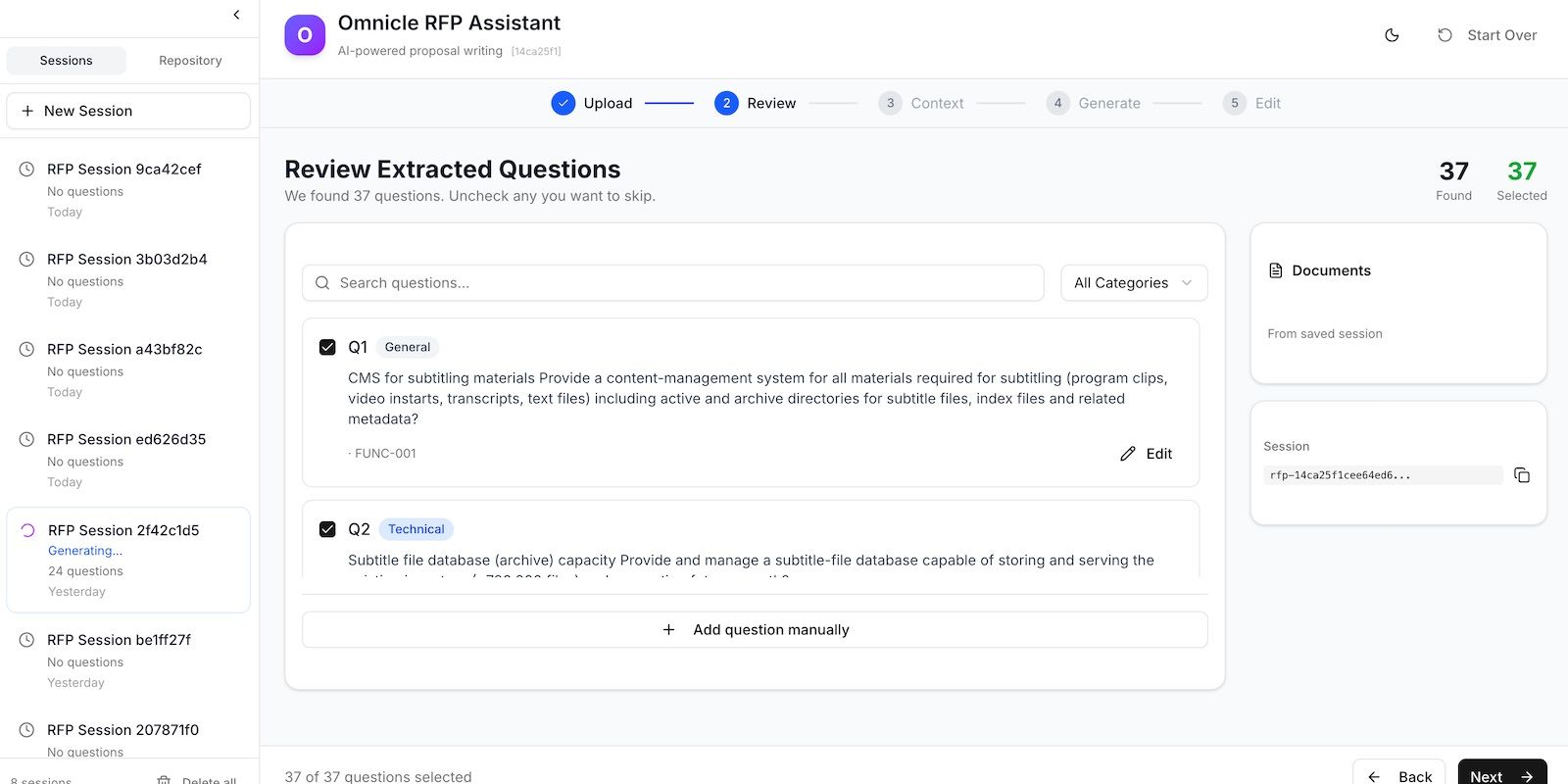
- Review parsed questions — the system extracts the questions; the user confirms or adjusts
- Set context — pick the product/service, tone, and key strengths to answer from
- Generate — AI drafts each answer with confidence indicators
- Edit & refine — rework answers in a rich editor, or ask the AI to rewrite a section inline
- Export — download a polished proposal as Word or PDF
Human in the loop
The design draws a hard line between machine-generated and human-edited content, so it’s always clear what came from the AI and what a person changed. Editing, approving and overriding are first-class — the assistant drafts, the human decides. The aesthetic is deliberately credible rather than flashy: a professional B2B feel, progressive disclosure so the interface never overwhelms, and graceful loading and empty states.
Under the hood
The front end is Next.js (App Router) with TypeScript, shadcn/ui and Tailwind CSS, state kept deliberately simple with React’s own primitives rather than a heavyweight store. The public demo runs against a mocked backend — fixtures behind realistic delays — so it stays fast and predictable in a partner meeting, but the flow it stands in for is where the real engineering lives.
That hard part is a RAG (retrieval-augmented generation) pipeline that embeds the company’s own documentation — past proposals, product specs, policies — into a vector store, so every answer is grounded in the company’s real material rather than a model’s general knowledge. On top of that sits a reinforced feedback loop: the human-in-the-loop edits and approvals aren’t just corrections to a single answer, they’re signal. Each accepted or rewritten response feeds back into retrieval and ranking, so the system learns which sources and phrasings win — and answering RFPs gets measurably more accurate and faster over time, the more the team uses it.
The bigger point
The RFP is just the costume. The same engine that parses RFP questions can parse training requirements, compliance checklists or onboarding forms — any document-heavy workflow. As the pitch puts it: you bring the domain expertise; we bring the orchestration.